Saturday, May 2, 2015

Le Marche en Vic en Bigorre

One of the largest weekly markets is located in Vic en Bigorre, about 20 minutes from Montegut. Today's market was well attended as usual. Since the weather has been mild residents are planning for flower gardens and window boxes, not to mention vegetable gardens. The market had something of everyone.


I think perhaps these poulet are ready for le pot! This breed is familiar around Montegut, probably good layers? But without feathers on their neck they look slightly bedraggled.


The white chickens were beautiful, the bit of black fringe really was striking.


This Artisan Bread table was a sight to behold. The baker gave me thumbs-up to take photos but he was busy answering questions and cutting samples. It was quite popular


Looks like he got up early to make enough product for the market. Extra large rounds to purchase by the kilogram.


Small loaves, seeded and traditional breads.


Baguettes! I think the AB on the sign means they are made with organic flour (ble).


Baskets were mounded high and crates were full at the beginning of the morning. But by the time we arrived there were still plenty of choices. The loaves below were full of seeds and nuts.


A basket of farm fresh eggs, cartons available for you to use and return next week! The eggs are not  sorted by size because you get the size the chicken lays... so at the market you get to choose what you like!


These onions were dug up just this morning, that is just as fresh as you can find! For only 6 Euros you will get about 30 onions - to replant or eat.


Small lettuce red leaf or green leaf and romaine, ready to plant.


Petit Pois - Peas in the pod, fresh and crisp. This mound of peas were gone within 10 minutes of this photo.


About 36 varieties of Olives!


A large table of at least 6 different kinds of homemade Nougat


The chocolate with blanched almonds looked heavenly.


and if you have, thanks for reading                                                    Linda

Thursday, April 30, 2015

A Simple Formula


On any given weekend, you can find us searching for interesting and intriguing pieces for sale at local Vide Greniers. Some call it Garage Sales, Flea Market, or Empty the Attic, and residents come out in droves to set up tables loaded with their unused but still useful (to someone) items. From furniture, lamps, baskets, espresso cups to baby clothes to hunting equipment, and rabbits and chickens, it's all there!

And if you've ever been to one, you know that it is also very likely that half of those items for sale are totally and completely useless to you! So it is with us, but once in a while, we are rewarded with an unusual find that fits our criteria. 

If we find it beautiful or useful or we simply love it, we'll find a way to put it to use! A simple formula that comes in very handy when it is time to decide to buy or not to buy.


This Grape Pickers basket is probably from the 30s or 40s and is in remarkable condition, as are the woven canvas straps. We have hung it from the coat rack in the upstairs hall, we get to look at it several times a day... we love it.


 This is a milk bottle carrier. It is galvanized steel and built to last. We found some ancient wine bottles, and it is useful as a doorstop.


The door up to the loft is heavy and often swings closed by itself. This is just the right height.


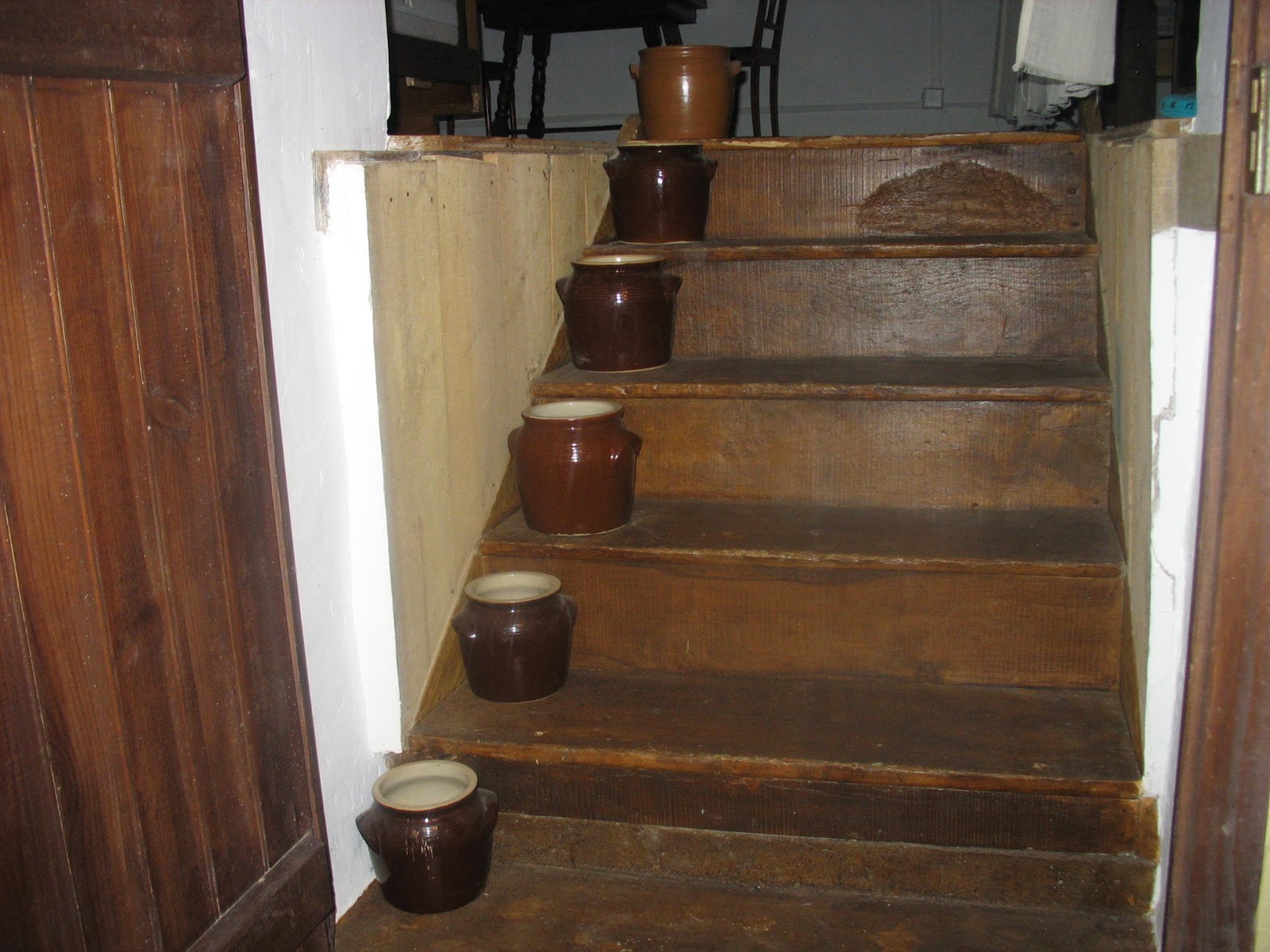
Here are the steps up the loft. We are still designing a safety rail, and the Confit pots remind us to watch our step.


The bathroom is quite small but efficient. Here is an ancient solid oak ladder we found in an unused area of the barn. The rotted ends were trimmed, and after a thorough scrubbing, it was coated with a couple of water-resistant wood stain coats.


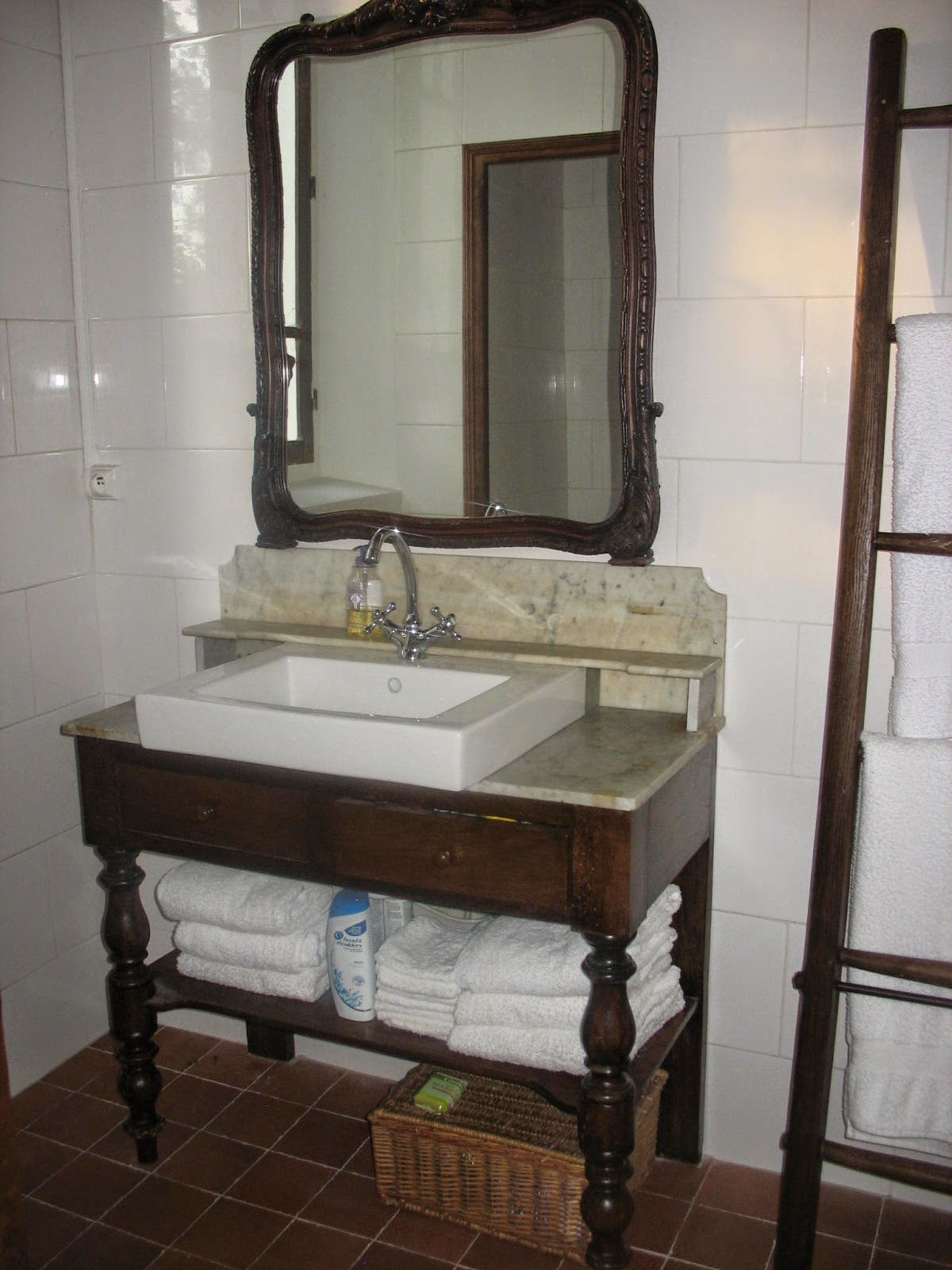
Early in the renovation project, we found this antique marble-topped oak table. Originally used in the bedroom, a water bowl and pitcher were placed here for "washing up." We plumbed a modern sink into it and topped it with a large mirror. The two small drawers and shelves come in handy.


This chandelier was found in a small second-hand store and surprisingly had all of its crystal pieces. In this tiny space, we had to find useful pieces but were lucky enough to find beauty.


And if you have, thanks for reading...    Linda
                    
Au Revoir,


Tuesday, September 9, 2014

Another major endeavor - Entry and Stairwell

Sheets of Masonite enclosed the ceiling of the approximately 25 foot tall stairwell. Without removing the panels we wouldn't know the condition of the ceiling. If it was it was truly awful it would have to be repaired. There was only one way to know...


This photo is of the first half of the false ceiling removed showing the condition of the chevrons and ceiling wood. Well now, at least, we knew the extent of the problem.

These walls had been blasted with a thick coat of pinkish colored stucco (1960's?) which did not age well. The white paint trim with the small red line was added by a cousin many, many years ago.

The dark wood on the right is evidence that rodents nested in this void probably in the 1940's. During WWII farmers in the area moved feed grains for their animals closer to the house to detour pilfering by the German military.

The ceiling was a highway into the attic and then only a short distance to the grain loft. The grain in the loft was removed when the rats were discovered. The Masonite cover didn't allow any air circulation and the wood had also been damaged from decades of summer humidity.


The pinewood cripple studs were only finished on one side and leaving the other sides very rough, the plan had been to cover them, forever.  However the wood was cleverly placed so that the false ceiling was flat.  The 200+ nails driven into the chevrons were difficult to remove, most of the chevrons are very old solid oak. Clearly recycled from another building.


This is one of 3 rodent nests. This hole goes up into the open attic space. We carried out bags of dirt and debris straight to the garbage every day. (Needless to say goggles and masks were the uniform of the day). Lots of sanding and water/bleach baths on the wood, it took several days but the wood finally dried and although it looked a bit dingy it was still about 500% improvement. Next came a through spray of pesticide to deter wood destroying pests.


This electrical conduit for the upstairs was added to the exterior of this wall. Here is a view of the wall/ceiling where there was no plaster or paint before the Masonite panels were placed.  At the left side of the blue conduit is another rodent entry area.  That rat had eaten through the wire insulation and was electrocuted.   The skeleton was stuck in the void and came down with the Masonite. Remains were quickly double bagged and even more quickly disposed into the garbage. Nasty work, but once the false ceiling was down there was nothing else to do but to carry on!
. 

.
Here you can see again there was no finish work above the white trim area


This is near the end of tearing out all the Masonite and beginning to repair the plaster around the top of the white trim area. The ladder was narrow even at the bottom level and made the process a bit dangerous not to mention uncomfortable. We used a lightweight scaffold that was too unsteady on the steps not to mention too short to reach the ceiling.


This photo from the entry area. On the right edge is the rough stucco texture we were eager to cover with plaster and fresh paint.


Debris on the steps in this photo and the one below from just one days work.


Finally the ceiling is taken back to the original wood. Through cleaning, sanding and several days for the wood to dry before the first coat of paint.


Barry begins plastering the walls in sections he can reach from the ladder or the lightweight scaffold.  This is very slow going work and after a few long days makes a decision.


The new scaffold arrives!  After much research a rental company is located and a heavy duty scaffold is found.
It went together like a jigsaw puzzle but it was tall enough, sturdy and steady. The many steps, very tall space made moving the scaffold tricky to position on the steps and still be efficient.
Jeremie was instrumental in the process, not only in locating the rental company but in jumping in with both feet and learning how to plaster walls 20+ feet in the air!


Each time the scaffold needed to be moved a complete dismantling was necessary.


Here is our life saver - Jeremie in person! He had never done any home repair/renovation work but was a quick study. Not only that but his technique and skills improved daily. We couldn't have done without him this year.


Primer coat complete -  now a dab of caulk here and there (actually 10 tubes) to fill the gaps and the finish coat of paint... finally!


I attempted a Faux finish on the door surround, looks good from about 20 feet?


Not sure if we are ready to put any paintings or photos on the walls yet, enjoying the change.


Finished! This photo shows the sleeve to cover the chandelier chain, lucky to find the exact color match. We love the outcome of this project, bright and airy and most of all clean.

And if you have thanks for reading


Friday, September 5, 2014

Shade Garden Update


Before I show you the finished shade garden here are a few photos as a reminder of our starting point.
There were two banks of rabbits hutches that sat in the area for decades.


 The rabbits were protected from predators and shielded from seasonal temperatures. You may be able to glimpse the second structure behind the right edge of the pen in the foreground.
Below is a closer view.


It may not be evident in these photos but the soil, even in this area, is naturally fertile. After many decades of housing rabbits it is easy to imagine how well our new plants will thrive.


Section by section the cages were dismantled and loaded onto the truck. I was not at all sorry to see them leave. 


Our friend and contractor took a few minutes to dig the area where several rose bushes would be re-planted. He was also kind enough to scoop up those roses from the kitchen garden where the septic fosse was being excavated. Full service? You bet!


More help to get the roses in the ground as soon as possible, our friend Jeremie was my hero,


Broken cement tiles filled in the swale where the second bank of rabbit cages sat. Terracotta roof tile delineates the pathway for the reclaimed space.


Barry and Jeremie cleaned out the second story of the barn and rescued several pieces of very old very hard oak and one slab became this rustic bench. The bench measures about 2 x 5 ft and 3 inches thick


Sunflowers define one side of the garden entry, Nicotania on the opposite side. A thick layer of new gravel is layered over GeoTex it promises to discourage weeds from growing (jury is still out for this year).


Roses are thriving as are the Hydrangeas, Impatiens and Calendulas. As the pathway curves into the heart of the area we have added annuals along the edging.

 
The hay I thought would make such a terrific mulch might be a better topping if the chickens weren't so curious.


You may not recognize the foreground as the former rabbit hutch location. A deep layer of gravel and it looks like it has been like this for years, well almost.


We're ready for family and friends! 


Finished just in time for the Family Fete.


About 51 family members came to Montegut this year. This was the perfect spot to begin the celebration. It was sincerely flattering to hear how much they enjoyed the shade garden. It is, after all, Maison de Familie!

And if you have thanks for reading

Linda


Friday, August 29, 2014

La Boqueria

Stepping out of the metro line deposited us directly in front of Barcelona's famous outdoor market - La Boqueria. I found this history of the market at:
 http://www.barcelona.com/barcelona_directory/monuments/boqueria_market

"The first mention of the Boqueria market of Barcelona dates from 1217, when tables were installed near the old door of the city to sell meat. From December 1470, a market selling pigs occurred at this site. At this time, the Market had the name Mercat Bornet or was (until 1794) simply known asMercat de la Palla (Straw Market).

At the beginning, the market was not enclosed and did not have an official statute, it was regarded as a simple extension of the market of Plaça Nova which then extended to the Plaça del Pi.
Later, the authorities decided to construct a separate market on La Rambla, housing mainly fishmongers and butchers. It is not until 1826 that the market is legally recognized and a convention held in 1835 decides construction of an official place.

Construction began March 19, 1840 under the direction of architect Mas Vilà. The market officially opened the same year, but the plans for the building were modified many times. The official inauguration of the structure was finally made in 1853. In 1911, the new fish market was opened and, in 1914, the metal roof that still exists today was constructed."


The most organized, cleanest and colorful marketplace I have ever seen.

A small bag of pepper followed us home.


Nearly anything you can imagine was available, from the simple to the exotic.


A feast for all of the senses!

Pitahaya

Texture of Kiwi, very mild flavor and not too sweet. I choose the pink version, tasty. You can see the whole fruit directly behind the cut fruit I can't decide which is prettier, the whole fruit or the cut fruit.


How I wish we could take one of those home, not the people the peppers!


Such abundance!


One of the dozens of fish counters.

Wonderful welcome to Barcelona, Spain.

And if you have thanks for reading.