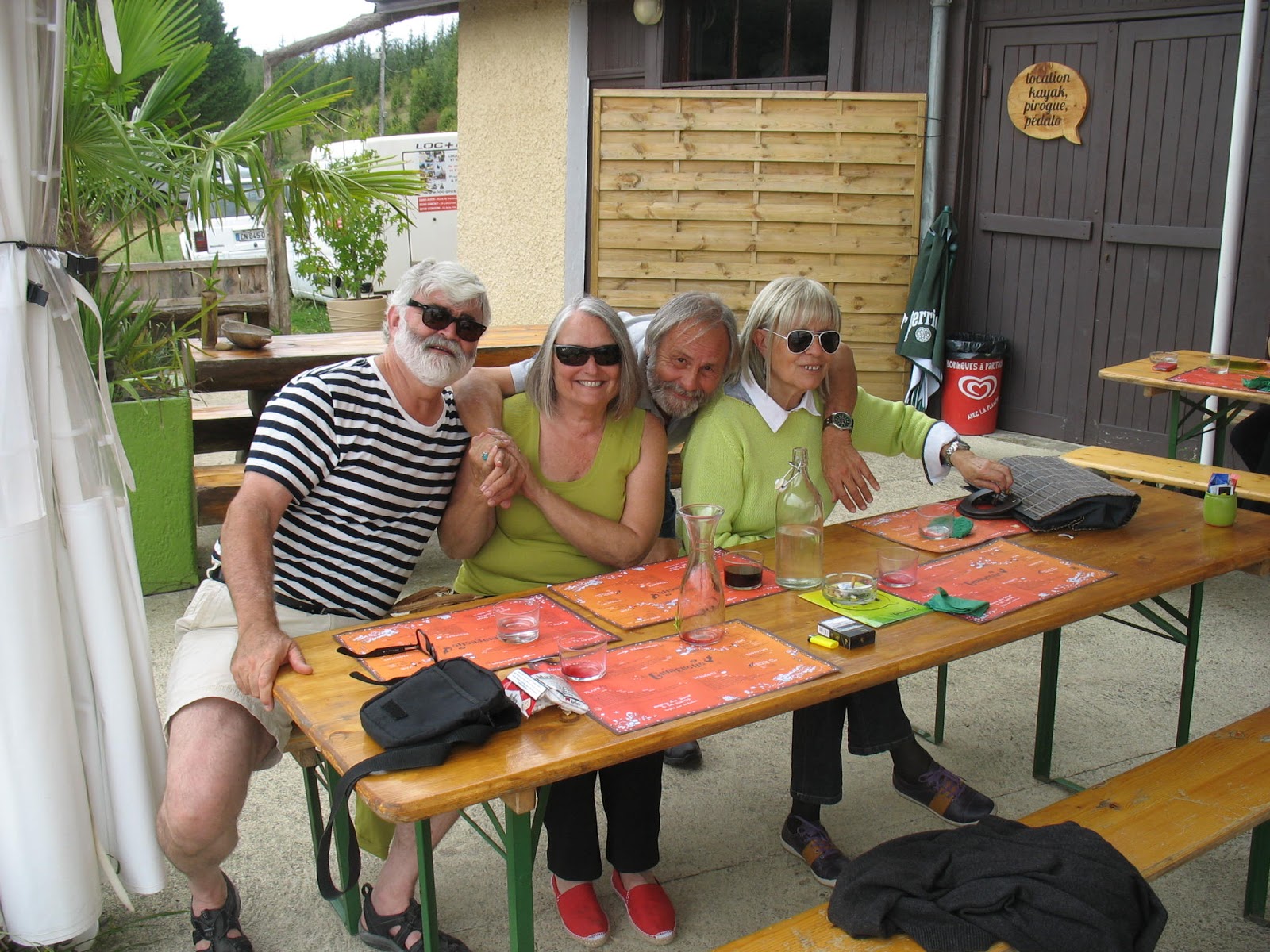
Wednesday, August 17, 2016

Pigs in the Pasture

"The “Bigorre” or “Noir de Bigorre” is a very ancient European breed of a black pig, with a black hide and narrow, horizontal ears. Although known for its strength and robustness, this is a likable creature due to a calm temperament and domestic nature.
This breed was fairly dominant until the 1970s. As it’s not suited to intensive livestock farming, they quickly began to disappear until a handful of dedicated supporters set out to “save the beast” in the ’80s. Since the early 1990s, approximately fifty breeders, two ham curers, and five pork butcher-caterers formed a conservation association. They have since established strict specifications for the care of and production of Noir de Bigorre, thus sustaining the breed for future generations."https://fr.wikipedia.org/wiki/Porc_gascon


And so our story of the pigs in the pasture began:

We selected two "Bigorre" pigs from a nearby farm in St. Sever de Rustan. They each weighed around 45 kilos and were the size of a hefty Cocker Spaniel, although heavier. 

This pen was used to weigh the pigs. Clearly, they can not be expected to stand quietly on the scale! The farmer chose two she thought were of similar size, wrangled them into the pen to be weighed. Slick system!

We were quite surprised by the condition of their farm. There were different holding areas. From securely fenced pastures to individual stalls (11) for females and their babies to spacious open areas near the barn with overhead canvas to provide shade, hold young males or females ready to be sold, and every single area appeared to have been recently cleaned. We were invited to come "whenever you wish" so they didn't clean knowing of our arrival! VERY impressed.


Expat neighbors van came in very handy for transport back to Montegut. Ray and Kitty Brown have become our "partners in crime." No crimes, just a lot of very unique experiences!


We used the same enclosure and fencing arrangement that the lambs enjoyed last year. The pigs were placed in the pen and immediately found a paradise of organic snacks!


A thick growth of various plants of which they soon made short work.


Happy pigs!


Pig "Eden" Quince, Plum, and Pear trees provide some shade. They settled in quickly to their new home.


Fast forward TWO months!! They sure made short order of the vegetation.


Eating became a competitive sport!


They grew rapidly with premium feed, hay, and baskets of fallen pears, plums, figs, and peaches.
We could tell them apart by their tails, one "curled" to the right the other to the left!


When they weren't eating, they "rooted" in the soil. Using their strong and tough snout as a shovel, they made short work of any soft soil. Together they managed to create deep trenches in several shaded areas where they enjoyed the cooler earth temperature.


Bigger and bigger.


They have nearly tripled in size and eaten nearly 2 hundred pounds of feed and vegetable and fruit scraps from two households twice a day. They also receive grass clippings along with a steady supply of culled fruit from the orchards' various fruit trees. They are particularly fond of the fig tree.

And if you have, thanks for reading.

Au Revoir!

Tuesday, August 9, 2016

Chartres

"Not only is Chartres Cathedral one of the greatest achievements in the history of architecture, but it is also almost perfectly preserved in its original design and details. Chartres' extensive cycle of portal sculpture remains fully intact, and its glowing stained-glass windows are all originals. Chartres is thus the only cathedral that conveys an almost perfect image of how it looked when it was built."

The Cathedral of our Lady of Chartres in Chartres's city center is elegant from every angle. A lovely surprise to find this view from our hotel window. Built between 1194 and 1260 in the Gothic architectural design. It was saved from looting and destruction by townspeople, quite extraordinary considering the vast number of churches destroyed during the French Revolution.

The city was captured during WWII because of its proximity to Paris, only about 50 miles. The Nazis established a strategic command post within the Cathedral blocks. This is credited to saving the oldest part of the city and where the Cathedral is located.


The majority of the interior has been beautifully restored. 


That is really some Pipe Organ!


Below is a section of the Choir Screen that was being restored during our visit. The original plaster was gently cleaned, and then a new "skin" was applied. This not only adds support but allows for the artisan to make repairs to the carving details.


And there is one now!


He told me it will take 7 years of cleaning, plastering, filling, and smoothing the new plaster to restore the design to match the original carvings on just the Choir Screen.


The dark area on this column is the un-restored section before and after at one glance.


 The stained-glass images are abstract and simple and appear after some contemplation.


And if you have, thanks for reading.


Avoir, Linda


Tuesday, August 2, 2016

Rocamadour

"Rocamadour is a small clifftop village in south-central France. It is known for the Cité Réligieuse complex of religious buildings, accessed via the Grand Escalier staircase. It includes the Chapelle Notre-Dame, with its Black Madonna statue, and the Romanesque-Gothic Basilique Saint-Sauveur."


One of the most popular tourist spots and well-deserved accolades! 

The story of Saint-Amadour, whose relics were said to be found in the village, was a hermit who sought solitude in Rocamadour.

From the top of the rampart, Rocamadour literally defies gravity and present day engineering! The little village is built, layer upon layer, into and on the stone face of the Alzou canyon. The small parking area at the top is approximately 150 meters down a pathway of switch-backs to the church. 

Attached to the castle, which is now privately owned, this viewing area is open to the public (2 euro) and offers remarkable 180-degree views.


A peek over the walkway into the courtyard of the castle.


Difficult at times to see where the building begins, and the rock ends.


 As early as the 12th-century pilgrims trekked to Rocamadour to visit this religious site. On their way to the chapel, they offered a prayer at each step.


Here is the famous "Black Madonna" in the tiny chapel. It is displayed simply. Hauntingly beautiful the chapel definitely emanates a sense of peace and awe.


And if you have, thanks for reading.

Aurevoir, Linda

Saturday, March 5, 2016

JP Darees


Sadly our cousin JP passed away. He was always very kind and generous to us. We miss him terribly. 


One of the last lunches we enjoyed in Lupiac with Odile and JP.


One of our favorite photos, taken in 2012 at the family fete held in Moumoulous. 


This photo was taken at the fete in Montegut with his lovely wife, Odile. Little did we know it would be the last time we would enjoy his company.


You'll always be remembered, JP!

And if you have, thanks for reading...

Au revoir!

Thursday, January 7, 2016

Village Des Bories


In 1977 the Village Des  Bories was classified as a Historical Monument. Located in Provence in the Luberon region, just a short drive from Gordes. 

About 30 stone huts scattered in an oak tree-studded area, all constructed of dry-stacked stones chipped from the local limestone. Many buildings were originally thought to house peasants' tools or provide shelter for the shepherds and their flocks. At a later date, larger huts were used for houses and stables.

The origin of the Bories has been dated as far back as the Bronze Age, with newer additions and structures in this location from the 7th and 15th centuries.

Thankfully a cousin suggested we explore the area, and we are so glad we took his advice! Enjoy some photos of our stop to explore these structures.


I hope these have piqued your interest in learning more about the Bories.


And if you have, thanks for reading.

Au Revoir

Tuesday, January 5, 2016

Antique Canopy


There just might be a blogger mandate that one must post a "before" photo! These might give you an idea of our starting point. Thus fulfilling said edict!


Here is the finished canopy. It was love at first sight with this unique antique.


The photo below is the bottom of the seat cushion. The canopy was built from 5 sections; Back, Sides (2), Cushion, and Base.  The surface is a mirror grain Walnut veneer over centuries-old hardwood. It is cumbersome!

The heavy cotton twill was quite faded. As the TV ads say: But wait ... there's more!


The red twill came off to reveal another layer of upholstery, a heavyweight blue and white linen twill. Once both fabric layers were removed, we discovered a series of tack/nail holes from even earlier covers. Hand-tied coiled springs boxed with heavy webbing were sturdy, all original, and in great condition.

This interior frame is solid oak, and the small rectangular pieces hold this section onto the base unit.


Below is a slightly different angle of the same side of the bottom cushion. Yes, those are square-headed nails along with several other sizes and types of nails and tacks.


 The canopy was disassembled, and the next step was to thoroughly clean the wood. I used an age-old and universal recipe; boiled linseed oil and turpentine.


The first layer of dirt came off easily using a light touch and super-fine stainless steel.
The next photo shows just how much a little bit of cleaning accomplished. Another layer of "Old Age" came off quickly with a second pass with the same solution and a soft cloth.


Here you can see the structure of the side pieces. Layers of horse-hair filling and perhaps various other mammals were held in place by the stiff side pieces. I tried to puzzle out what the content might be with no luck - it was rigid and covered with handspun linen or flax. The filling had sagged badly, and we decided to make a fresh start.


The bottom cushion was covered with a batting section, then covered with fresh linen and stapled in place. The bottom cushion


 T was set onto the base to confirm that not too much padding had been added to the piece.  The sides are first attached to the base unit, and the bottom cushion sits snugly between them. The back section is attached separately and held in place with long posts that fit into slots.


Good fit! Now we take it apart once more to cover the linen with upholstery fabric.


The story of our upholstery fabric is an odd one. Here is the short version.

Sometime in the '90s. Rather than buy new furniture, we decided to have it all reupholstered. Fast forward to 2010 when those same yards and yards of 4 different upholstery fabrics, having never made their way onto any of the original furniture pieces, were folded and stuffed into luggage to be used in Montegut!

The side pieces were re-stuffed with oversized down pillows in new cases and covered in linen before the upholstery fabric. Small lengths of foam were added to keep the down from shifting.


Here is the bottom cushion nearly finished. The chair in the background is another project... still a work in progress.


Next, we were ready to move on to the back and side cushions. All three pieces, back, and sides, had cording to finish the visible edges.


Matching stripes proved to be only one of the challenges with this project! This photo shows how nicely those stripes all came together... whew!


And if you have, thanks for reading!

Au revoir