Saturday, November 23, 2019

La cuisine est finie!

What a joy it was to work toward the final finish of our kitchen. As with the other rooms we've renovated over the years, our target was a functional and purposefully designed room.

We are thrilled to have found a local carpenter who was able to work within our time frame. Thanks to a cousin who lives nearby, the windows were fitted during our absence in 2018. We received photos after the installation. Seeing both the window and the door in person made for a happy return.


The only window in the kitchen is on the north-west wall. It was smallish and replaced with an oak framed double-pane glass. The exterior was painted for protection from the changing weather. All the other windows will be replaced, and the exterior trim color will match.


The kitchen garden door brings much-needed light into the kitchen. It is situated directly under the "Juliet balcony" of the guest room.

The Boston Ivy or Virginia Creeper was planted years ago and continues to grow hardily to cover the entire wall. A small area on the front wall is slowly being covered, and we celebrate the new growth when we return. The Virginia Creeper sends out runners that cling to the surface and absorb moisture. This trailing plant does not wedge into cracks or soft spots.

 
A glance back to the original kitchen garden door. We changed the location of the hinges to open on the opposite side.
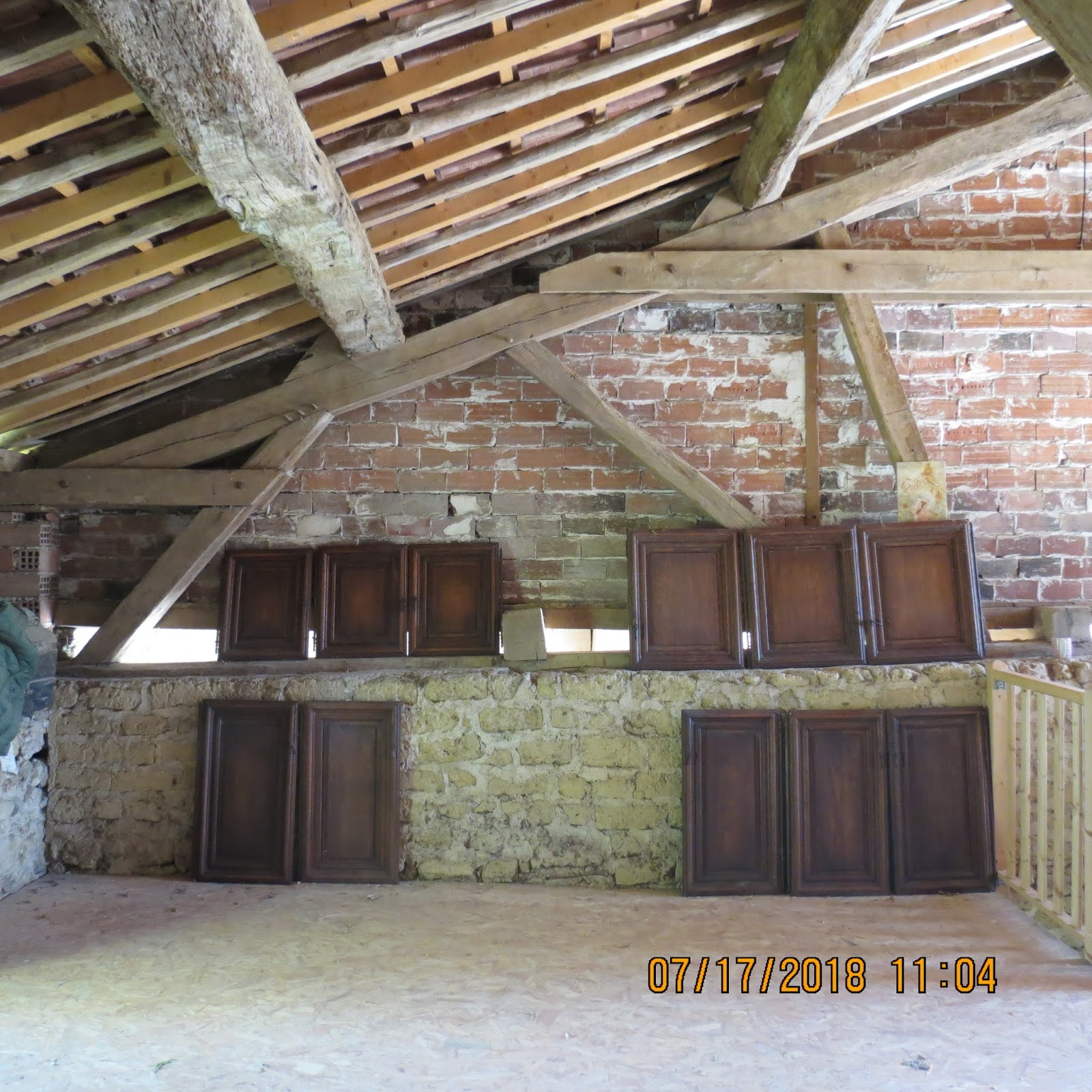

Several years ago, we found oak cupboard doors at a local Vide Grenier. This translates to "empty the attic." I finally got around to dusting them off and taking a photo just before the carpenter loaded them into his van for restoration.


The stain was very old and very dark, not to mention very dirty.  Le Charpentier tested the finish and checked the strength of ancient construction. He removed the hinges and pulls from the doors, the old brass pulls would be reused, but new hinges would be installed.


 Luckily the stain could easily be removed, and to keep costs down, I volunteered to strip the stain from the outside frame of each door. After 3 separate applications of the paint/stain stripper, the results were encouraging.


Only 13 more frames to go.  As the temperature rises, the paint stripper works faster, but getting this job finished is the priority!


Cabinets, both upper and lower units, were installed in our absence. The frequent question has been, "weren't you anxious to have this all down without being present"? We both felt the carpenter was so skilled and intuitive with our vision we were very comfortable. He was always the consummate artisan. We viewed his previous work in the area, we visited his home and family and his workshop. He and his lovely wife easily became friends as well.


Both the plumber and electrician spent a few days working to add the necessary elements to make the space functionally perfect.

The next hurdle was choosing material for the countertops. I wanted a solid surface that was heavy-duty, as in all likelihood will be in place for several decades. Every recommendation was the same, a local company at the base of the Pyrennes and only 45 minutes from Montegut. 


Less than a week after reserving the granite slab, the company owner arrived with his computer/tripod and laser! Measurements were taken every 5 centimeters to ensure a perfect fit. Less than an hour later, he was packed up and gone.


Measured, trimmed to fit perfectly. No problems, not a single one! They fit the faucet and sink. All the surfaces were cleaned and polished, even to my mother's exact standards!


With help from a few friends, the appliances from the upstairs kitchen are in place, and the dishwasher is installed!

There is not a thing we would change. The kitchen reflects our wish to create a functional and modest space.  It works perfectly for us and, hopefully, for many generations who come to Montegut.

And if you have, thanks for reading.

Au Revoir


Thursday, September 5, 2019

Kitchen doorway

The doorway from the dining room into the kitchen was entirely too low for anyone of average height. It would need to be raised by at least 6 inches.


When the house was built, the door frames were made from solid oak hardwood, two upright side posts, and an arched header across the top fitted by mortise and tenon.  The bottom of each pillar was initially buried in the dirt. Although now, those bases were rotted and needed replacing before we went much further.

The dining room has an enormous fireplace next to the carved Soapstone counter and a small sink on the east wall. The family's meals were cooked in the fireplace. It was in use until a modern kitchen with running water was added across the back of the house, perhaps Mid-Century. The doorway was constructed through the north exterior wall, which was fully 1 meter deep.


There is a tell-tale sign of the original arch's slight curve. Look closely to see the stacked tile edges in the corners. Long nails were pounded into the oak and then bent to create a surface that held the plaster in place for several decades.

The frame was exposed to reveal the underlying structure. How much of the header to remove and still maintain the wall/ceiling's integrity became the primary concern.


Here Barry measures how much of the side pillar must be replaced. About 1/3 of that side was merely non-existent! The right side faired only slightly better.


Initial vertical cuts on both sides were carefully calculated... slow and steady... cutting more is always an option. But UN cutting was not!


Crafting an arch into the doorframe rather than a straight horizontal top would allow safer passage without compromising the entire doorway.


The first cut is on the conservative side. Cutting out a flatter curve allowed us to create the perfect arch. 


The second cut is perfect!


Now the kitchen side of the doorway ceiling has to be raised! The ceiling portion of this doorway space might be a game-changer.


Lots of exploring and advance planning. At one time, this area had been an exterior wall, so it had been built for strength rather than beauty. The void after all the loose stones and cement fell out was about 14-15 inches deep!


Bits of the remaining rubble that hadn't fallen out had to be removed, but the structure still needed to be braced while the deep voids were filled. Those areas were reinforced beginning from each side then rebuilding slowly toward the middle.

Each layer needed time to dry, so we used a Tunnel Jack or Screw Jack and a few wood pieces to hold the rock and cement in place while it dried.

Now, filling the empty spaces could begin, and we worked from the sides toward the center. The large gap was reinforced and filled with stones and cement, then allowed to cure or dry.  After about four days, the cement was thoroughly dry, and the ceiling seemed to be stable now; it was time to remove the jack!


This view is from the kitchen into the dining room.


This photo shows one of the mortar and tenon joints near the top of the side. The newly rebuilt door frame and the ceiling were ready for plaster. During the summer months, the weather is hot, so the plaster will dry quickly.


No more head bumps walking into the kitchen. But that kitchen... oh, my! Stay tuned for perhaps the most significant renovation so far!

Friday, May 24, 2019

Hangar: a French shed


This is not the oldest structure on the farm, only dating from the mid-1700s. The earliest was a small two-room house with attached dairy typical in this region built-in 1640. As the family grew and the farm grew more profitable, a separate house was built.


This hangar was built from rocks harvested from the surrounding fields. The stone and cement base was built to the historical high-water mark. Then handmade adobe blocks approximately 1/2 meter x 1/2 meter in size, some larger, some smaller, are stacked.  Large oak trees are honed and used as posts of the opening and the joists for the roof.

*During this time, mills in the Pyrennes were able to be quite accurate in the dimensions. There was a water-driven mill nearby that perhaps provided these large timbers.


In the 1900s, the hangar was extended to provide bays for farm equipment. You can clearly see the difference in the roof tile. From the original hanger's handmade flat tiles to the manufactured rounded tile of the extension, little else has changed. Several years ago, we had this roof repaired and stabilized.

And if you have, thanks for reading...

Au revoir


Tuesday, January 8, 2019

Is it Kidnapping or a Rescue?


Returning from a pastry-run for croissants to accompany our morning coffee we came across this little guy! Curled up tightly right in the middle of the road. He was thankfully uninjured, but in all likelihood would not stay that way for much longer. The narrow single lane road that runs past Montegut is not busy but there is no room to steer even the tiniest of cars to miss a small animal in the road. And especially one that looks like a big dirt clod from a distance. Using a small towel we wrapped him to protect our hands and to keep him calm.


Checking in with Wikipedia this is what we learned:
A hedgehog is any of the spiny mammals of the subfamily Erinaceinae, in the eulipotyphlan family Erinaceidae. There are seventeen species of hedgehog in five genera found through parts of Europe, Asia, and Africa, and in New Zealand (by introduction).
LifespanWoodland hedgehogs: 2 – 5 years
Scientific nameErinaceinae
ClassMammalia
MassWoodland hedgehogs: 0.88 – 2.6 lbs, Desert hedgehog: 0.62 – 1.1 lbs, Daurian hedgehog: 1.3 lbs
Gestation periodWoodland hedgehogs: 30 – 40 days, Desert hedgehog: 30 – 40 days
Did you knowHedgehogs can travel up to 3 km in search of food.


Clearly, the best place for our new garden resident was in the shade garden HEDGE! He should be ever so happy to dine on the numerous insects and snails/slugs in this garden. I for one would be thrilled if he would invite a few more friends to move in as there is lots of room with an abundance of nourishment!


Okay little one, go forth and forage.


He stayed in the protective position until we were safely out of site. Within a few short moments, our new little resident had disappeared under the canopy of overhanging branches for safety.


And if you have, thanks for reading 

Au Revoir

Monday, December 31, 2018

Évolution de la Cuisine; le Plancher


Tile floors were the preferred flooring during the time Montegut was built. We guess it was sometime in the very early-1800s.  A foundation of packed soil and sand was common and has proven to be durable. However, due to settling, all the downstairs floors have many cracked or even shattered tiles.  Replacing damaged tiles was not an option as they are no longer available.

Once the walls and ceiling are replastered and painted, the floor is next on the list.


The first step to prepare the floor was to level the existing surface.  A 1-meter grid was laid out using small hexagon tiles - here, you see three tiles that identify how much material will be needed to bring that area up to level.


A float is a pure cement mix sans gravel that was poured to cover an area about 1 square meter at a time. Barry got very good at pouring that float to the exact level!


If you search, you can see a few spots where the small tiles are identifiable. At the end of this workday, a total of 8 bags (80 lbs each) of the float had been used to level the kitchen floor!


We returned to the kitchen project after enjoying visits from family and friends. Tile placement was first sketched out on paper, but seeing the tiles on the floor was important. Taking into account the uneven walls, placement of cabinets and appliances helped us make some minor adjustments.


Together we settled on the layout!


Thorough cleanup and final layout to mark cuts, and we are ready to mix some mastic!


All goes well, and only a few simple cuts are needed. As we've learned, there is always something that pushes us to master a skill, and this last cut was a challenge.


And he does it again!


Our quality control consultant Millie checks one last time before the grout goes on.


A narrow baseboard of tile is added for a tidy finish, and it is done!

And if you have, thanks for reading
Au Revoir